
Starting the day in a healthy way

Starting the day in a healthy way
A healthy breakfast helps children start the school day ready for learning, but it can be challenging to achieve. The C.S. Mott Children’s Hospital National Poll on Children’s Health asked a national sample of parents about breakfast habits for their children age 6-12.
Most parents say that, on a typical school day, their child eats breakfast at home (68%), while others eat breakfast at school (23%) or on the way to school (5%); 4% of parents say their child does not usually eat breakfast. One-third of parents (35%) report their children have 15 minutes or less to eat breakfast, 47% have 15-25 minutes, and 19% have 30 minutes or more. Parents say their child typically eats breakfast with a sibling (66%) and/or parent (49%); 16% eat breakfast alone.
Among parents of children who eat breakfast at home or on the way to school, 53% say their child usually decides what they will eat. Two-thirds of parents (69%) say it is very important to offer something their child likes, while others say it is very important to choose foods that are quick and convenient (37%) or easy for the child to prepare themselves (25%). When buying breakfast cereal, parents often consider their child’s preference (65%), and nutritional content such as protein or fiber (60%), calories or added sugar (37%), cost (34%), or artificial coloring (23%).
The nutritional content of children’s breakfasts varies. In estimating how often their child’s breakfast includes protein, 39% of parents say most days (4-5 days/week), 43% some days (2-3 days/week), and 18% few days (0-1 days/week). For their child’s breakfast including fiber, 37% of parents say most days, 43% some days, and 20% few days. For whole or cut fruit, 36% of parents say most days, 38% some days, and 26% few days. For breakfast low in added sugar, parents report 34% most days, 46% some days, and 19% few days. Parents who say their child usually decides what they will eat also report fewer days per week that their child’s breakfast includes protein, fiber, fruit, and is low in sugar.
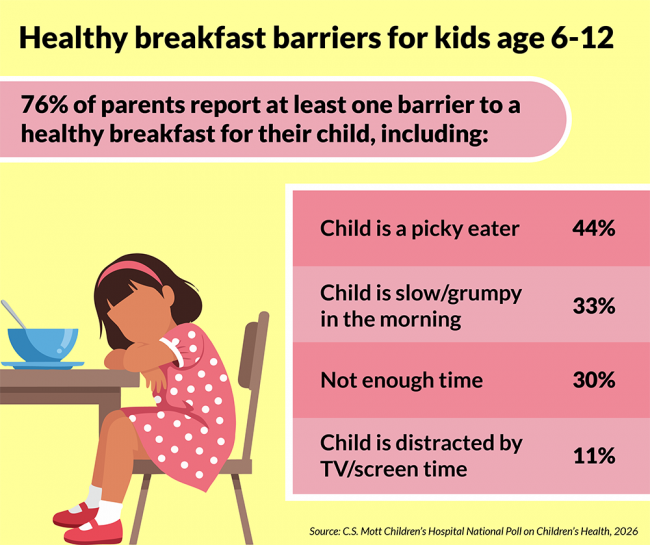
Three-quarters of parents (76%) cite at least one barrier to a healthy breakfast, including their child being a picky eater (44%), being slow or grumpy in the morning (33%), not having enough time (30%), or being distracted by TV/screen time (11%).
Highlights
- Half of parents say their child chooses what to eat for breakfast.
- 3 in 4 parents cite at least one barrier to their child having a healthy breakfast.
- 1 in 6 parents say their child eats breakfast alone.
- 1 in 3 parents say their child has 15 minutes or less to eat breakfast.
Implications
Eating breakfast helps children begin the school day with energy and readiness to learn, and findings from this Mott Poll are reassuring: nearly all parents report that their child age 6-12 usually eats breakfast on a school day. Although eating something in the morning is an important first step, what children eat can influence how satisfied and prepared they feel as they begin the school day.
A balanced breakfast includes foods that provide protein and fiber, with little added sugar. However, 1 in 5 parents say their child’s breakfast rarely meets these goals. As many parents buy breakfast foods based on their child’s preferences, finding new options that the child enjoys is key to a healthier breakfast. One approach is to substitute healthier ingredients in the breakfast options that kids already enjoy, such as putting peanut butter on toast instead of jelly to offer more protein, using whole-grain instead of white bread for more fiber, or making a smoothie with whole or cut fruit rather than serving juice.
In many families, children decide what they will eat for breakfast. This is generally a good thing, as the child has some control over what to eat, while allowing the parent to set reasonable boundaries around what is available. However, this Mott Poll found that when children choose, their breakfast tends to be less healthy. This signals that parents need to ensure that their child is choosing from an array of nutritious options. Involving children in choosing foods at the grocery store or preparing simple items the night before may increase both their independence and willingness to eat the food.
For many families, mornings before school are hectic, and 1 in 3 parents say their child has 15 minutes or less to eat breakfast. Therefore, many parents prioritize convenience – but this doesn’t need to mean unhealthy. Parents can make healthy options in advance, such as low-sugar muffins, mini-quiches, or fruit cups. Leftovers also can be a practical breakfast option; younger children may be delighted to eat them at the “wrong” time of day. Cereal can be a convenient yet healthy option, if parents choose varieties that contain fiber and are low in added sugar.
Most parents identify at least one obstacle to their child having a healthy breakfast. The most common challenges include picky eating, being slow or grumpy in the morning, and not having enough time are familiar issues for families with school-age children. Parents can reduce morning conflict by offering a small number of familiar choices, preparing food in advance, and adjusting routines so children have enough time to wake up and eat. For children with persistent or highly restrictive eating patterns, a pediatrician or dietitian may be able to suggest strategies for meeting nutritional needs while gradually introducing new foods.
Breakfast can also provide an opportunity for family connection, but one in six parents say their child eats breakfast alone. Sitting together may not be possible every morning, but even sharing breakfast occasionally gives parents a chance to model healthy choices, check in with their child, and create a calmer start to the day.
There is no single breakfast routine that will work with every family. A realistic goal is to identify options that fit the family’s schedule, provide some nutritional value, and are foods that the child will actually eat. Small changes can help families build a healthier and more manageable morning routine.
Data Source & Methods
This report presents findings from a nationally representative household survey conducted exclusively by Ipsos Public Affairs, LLC (Ipsos) for C.S. Mott Children’s Hospital. The survey was administered in July 2026 to a randomly selected, stratified group of adults who were parents of at least one child age 0-18 years living in their household (n=2,027). Adults were selected from Ipsos’s web-enabled KnowledgePanel® that closely resembles the U.S. population. The sample was subsequently weighted to reflect population figures from the Census Bureau. The survey completion rate was 69% among panel members contacted to participate. This report is based on responses from 1,037 parents with at least one child age 6-12. The margin of error for results presented in this report is ±1 to 4 percentage points.
Findings from the C.S. Mott Children’s Hospital National Poll on Children’s Health do not represent the opinions of the University of Michigan. The University of Michigan reserves all rights over this material.
Citation
Woolford SJ, Gebremariam A, Beel L, Schultz SL, Clark SJ. Starting the day in a healthy way. C.S. Mott Children's Hospital National Poll on Children's Health, University of Michigan. Vol 50, Issue 1, August 2026. Available at: https://mottpoll.org/reports/starting-day-healthy-way.


